The shift OEE comes in green and someone asks whether the line is “well utilized.” That question mixes two clocks. Overall equipment effectiveness (OEE) looks at the time you already declared as planned: it multiplies availability, performance, and quality. The EPA presents the index that way on its TPM page. EPA, Lean Thinking and Methods - TPM
TEEP (Total Effective Equipment Performance) changes the denominator. It looks at full calendar time, often 24 hours × 7 days, and multiplies OEE by utilization. OEE.com, Calculate TEEP
Watch only the daily percentage and the blanks disappear from the conversation: Saturdays with no crew, a third shift that never existed, windows with no orders. Those hours are not irrelevant. OEE simply starts after that schedule loss has already been subtracted. OEE.com, OEE Factors
This guide does not rebuild A×P×Q, and it does not retell the breakdown morning that never lands in the score. That story sits in what OEE is, and the breakdown morning it never counts. The question here is narrower: what TEEP is, how it relates to OEE, and how not to treat the daily % as calendar utilization.
The example numbers are hypothetical. They do not describe a real plant or an ROI. WizeeMind gathers plant evidence with source, time, and asset limits; it does not calculate official TEEP or OEE.
What TEEP is in a plant that already watches OEE
TEEP answers a different question from daily OEE. OEE.com defines it as a performance metric that gives a view of the true capacity of the manufacturing operation: it accounts for equipment losses (the ones OEE summarizes) and schedule losses (the ones utilization summarizes). You calculate it by multiplying availability, performance, quality, and utilization, or equivalently as TEEP = OEE × utilization. OEE.com, Calculate TEEP
Its FAQ draws the contrast cleanly: OEE measures the ratio of fully productive time to planned production time; TEEP measures that same idea against all time (24/7). A TEEP of 100% would mean making only good parts, at ideal cycle, with no stops, 24 hours a day, 7 days a week. OEE.com, FAQ OEE vs TEEP
TEEP is not “the good OEE,” and it is not a moral grade for the plant. It is another frame. If you already calculate OEE by shift or by day, TEEP adds what the daily report usually leaves out: how much of the calendar was never scheduled at all.
The OEE.com glossary calls that factor utilization: the percentage of calendar time used for production, with losses from unscheduled production and from plant closed periods. OEE.com, Glossary Utilization
JIPM places OEE as a representative equipment-efficiency indicator created with TPM and used today by many companies whether or not they have introduced TPM; it also mentions it alongside IATF 16949 and ISO 22400-2:2014. JIPM, About TPM / OEE
TEEP does not replace that equipment-loss map. It widens the view toward the calendar. If the meeting only asks “how was the shift?”, a well-defined OEE can be enough. If it asks “how much of the weekly clock did we actually use?”, OEE alone does not answer.
ISO 22400-1 offers a framework for defining and using operations KPIs; ISO 22400-2 documents KPIs with formula, elements, and time behaviour. ISO 22400-1:2014 ISO 22400-2:2014 That does not mean your daily report uses TEEP, or that a vendor means the same thing OEE.com means when it prints the acronym. Before you stick TEEP on a dashboard, write down the denominator, the period, and what counts as planned production time.
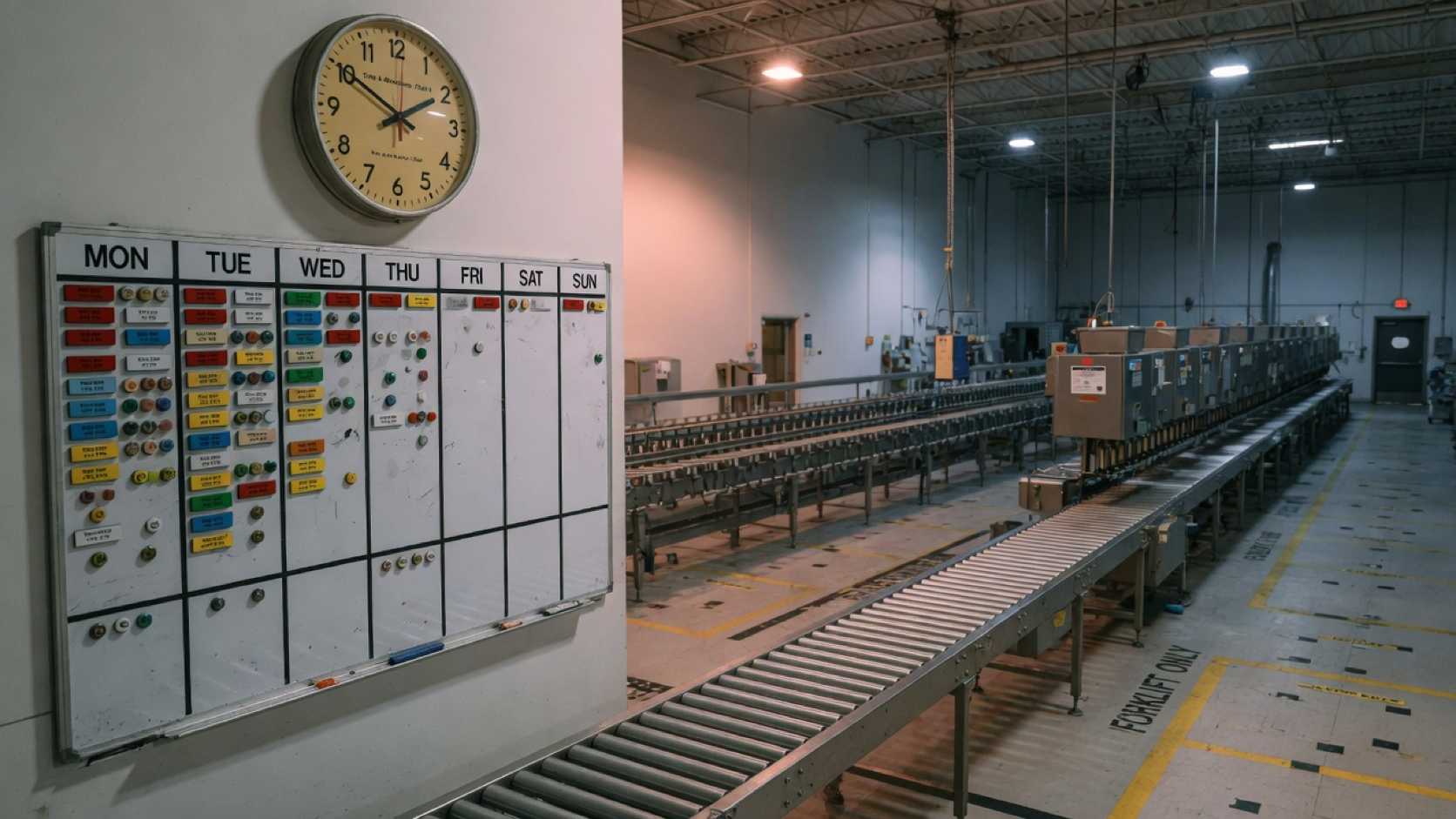
On the floor, TEEP makes visible what the weekly board already shows in blank cells: Saturday with no shift, Sunday closed, nights without staffing, a week with a single shift because there is no order. That is not Friday’s breakdown. It is unscheduled calendar.
If someone treats Friday’s OEE as proof that “the line is heavily utilized,” they are reading the wrong clock. The same discipline of writing the question before the percentage shows up when you compare plant performance when sites measure differently.
English search results for “what is TEEP” and “TEEP vs OEE” usually land on the same split: OEE against planned production time, TEEP against all calendar time, linked by utilization. That framing is useful. It still needs your local card for what “planned” and “all time” mean before the acronym travels between plants.
OEE uses planned time; TEEP uses the calendar
The boundary between the two indexes is clearer if you start from All Time. OEE.com also calls it 24/7 time: every minute of every day. From there you subtract schedule loss: plant shutdowns, breaks/meals, or periods with no intent to produce. That loss belongs to TEEP. It does not belong to OEE. What remains is planned production time. OEE starts there and examines efficiency and productivity losses inside that time. OEE.com, OEE Factors
When the EPA explains TPM, it presents OEE as the product of overall equipment availability, performance, and the rate of quality products, so you can see how much time goes into each major loss and where to look. EPA, Lean Thinking and Methods - TPM That product lives inside the time the plant already decided to schedule. It does not tell you what fraction of the weekly calendar stayed outside the schedule.
OEE.com puts the contrast in one operating sentence: OEE measures the percentage of planned production time that is truly productive; TEEP measures the percentage of all time that is truly productive. OEE.com, Calculate TEEP
If your TEEP is low with a high OEE, the usual reading is not “the shift was bad.” It is “you schedule little of the calendar” or “you leave a lot of time with no intent to produce,” on top of the losses inside the shift.
The utilization formula on that page is direct: utilization = planned production time / all time. Then TEEP = OEE × utilization. OEE.com, Calculate TEEP
Example published there (not a figure from your plant): OEE 65%, two 8-hour shifts × 5 days = 80 planned hours, weekly calendar 168 h (24×7), utilization 80/168 ≈ 47.62%, TEEP ≈ 30.95%.
The 65% is not “awful by itself”; the calendar in use is limited. If you only stare at that 65%, you can believe the problem sits inside the shift. TEEP forces you to look at the 88 unscheduled hours as well.
SEMI E10, in semiconductors and related industries, defines basic equipment conditions, RAM metrics, and utilization measurement for a common language between suppliers and users. Thomas Pomorski states that framing on the SEMI page. SEMI E10, Pomorski You do not need to implement SEMI E10 in packaging to take the point: utilization and availability are not synonyms. Serious time models keep unscheduled time separate from stops inside scheduled time.
ISO 22400-1 reminds you that a KPI is built with declared criteria and a framework; it does not turn a daily percentage into an international benchmark. ISO 22400-1:2014
When you compare shifts or plants, equalize the denominator and the planned-time boundary first. The same rule shows up when you compare plant performance when sites measure differently. Without that card, a “high” OEE and a “low” TEEP fight in the meeting even though both can be true at once.
JIPM keeps OEE tied to clarifying equipment losses against ideal operation. JIPM, About TPM / OEE Calendar time you never scheduled is schedule loss, not a bearing failure. If the report mixes those stories into one color, the action plan gets absurd: you try to “fix” a closed Saturday as if it were mean time to repair.
What the calendar leaves out of the daily percentage
The daily percentage can look comfortable while the weekly board is half empty. That is not an Excel trick. It is how OEE is designed. Schedule loss (plant closed, no shift, no orders, and often breaks if you exclude them from planned time) stays outside the OEE calculation and inside TEEP. OEE.com, OEE Factors OEE.com, Glossary Schedule Loss
Picture a hypothetical packaging hall. Monday through Friday there are two shifts. Saturday and Sunday the hall is dark. Friday’s OEE closes high because, inside planned time, the line ran with few logged stops, solid rate, and little scrap.
On Monday, over coffee, someone says the line is “heavily utilized.” The weekly board says something else: two full days blank and, if you look at 24×7, the nights without a third shift as well. Friday’s OEE is not lying. It also does not measure the calendar.
OEE.com calls that gap a “hidden factory” when you look from TEEP: potential capacity not used with the equipment you already have, including unscheduled time. OEE.com, Calculate TEEP
Seeing the gap is not the same as ordering Saturday open. Opening Saturday needs demand, staffing, maintenance windows, quality cover, and a cost case. The index only makes the blank cells harder to ignore. Treating “visible” as “mandatory” is the usual management error when TEEP enters the room without that context.
The EPA links TPM to eliminating losses (breakdowns, setups, minor stops, reduced speed, defects, startups) and to better use of assets and capacity when breakdowns and defects fall. EPA, Lean Thinking and Methods - TPM
Watch the word utilization there: it points to the result of cutting equipment losses, not to the TEEP formula Utilization = planned / calendar. Do not mix that language with OEE.com’s Utilization factor unless you declare which one you are using.
JIPM insists on clarifying and quantifying losses against ideal operation. JIPM, About TPM Unscheduled calendar is schedule loss, not a breakdown. If you put it in the same bucket as a failed bearing, the action plan becomes nonsense: you try to “repair” a closed Saturday as if it were MTTR.
NIST MEP documents, in the Keats case, a system that collected cycles, available current for production, and defects to calculate OEE. Brian Keats wrote that with TMAC they could track the overall efficiency of a key press. NIST MEP, KEATS Hydraulic Press OEE System
It talks about OEE and acting when the index drops. It does not publish TEEP or a closed savings figure. Without a declared data chain, the acronym does not carry the meeting. If the decision is about weekly capacity, bring an explicit row for unscheduled time next to the daily %.
Spreadsheet productivity leaves things out too; that is covered in how you calculate productivity in a spreadsheet. Here the concrete gap is calendar versus daily OEE.
ISO 22400-2 presents KPIs with formulas and associated elements; having a definition standard does not mean your weekly pack uses TEEP. ISO 22400-2:2014 Declare All Time and planned production time before you multiply. Otherwise the committee argues about a color while the board stays blank on the weekend.
Utilization versus availability
This is where meetings go sideways. Someone says “availability” and means Saturdays. Someone else says “utilization” and means breakdowns. Different clocks, same argument.
In the OEE.com frame, availability is the ratio of run time to planned production time. It captures availability losses: unplanned stops (failures, material shortages) and planned stops inside scheduled time (changeovers, adjustments). OEE.com, OEE Factors Utilization is the ratio of planned production time to all calendar time. It captures unscheduled production and plant not open. OEE.com, Glossary Utilization
A short hypothetical: the line has 80 planned hours in the week and 168 calendar hours. Utilization ≈ 47.6%. Inside those 80 hours it runs 72 hours under the local rule. Availability = 72/80 = 90%. Availability can be high and utilization low at the same time. OEE will use that 90% (with performance and quality). TEEP will multiply OEE by about 0.476. OEE.com, Calculate TEEP
SEMI E10 works with mutually exclusive states and RAM and utilization metrics; Pomorski notes that this base feeds capacity and constraint analysis and links to equipment productivity metrics (SEMI E79) and factory metrics. SEMI E10 Even if your plant is not in semiconductors, the warning holds: if you do not separate unscheduled time from stops inside scheduled time, the hallway “% available” can mix three stories.
The EPA calculates OEE by multiplying availability, performance, and quality; that page does not fold in TEEP’s calendar utilization factor. EPA, Lean Thinking and Methods - TPM
ISO 22400-2 documents KPIs with formula and elements; the catalogue abstract does not hand you a mandatory TEEP or a “good” utilization threshold. ISO 22400-2:2014 Local discipline matters more than the acronym: write what is planned, what is calendar, which stops subtract from availability, and what stays only in utilization.
If the problem is a long changeover or a breakdown inside the shift, you look at availability (and the rest of OEE). OEE.com, OEE Factors If the problem is that the week only schedules one shift or closes the weekend, you look at utilization and TEEP. OEE.com, Glossary Utilization
If you mix both (“we are not available on Saturday”), the action usually comes out twisted: you treat a planned closure as a failure, or you ignore a failure because “anyway, we do not produce on Saturday either.”
When leadership wants a single number, say it with both clocks: OEE for the planned period, utilization of the calendar, TEEP as the product. Without that, the committee debates a color while the weekly board stays blank. ISO 22400-1:2014 frames how a KPI is defined and used; it does not excuse skipping the definition card. Ask out loud whether you want to know how planned time went or how much of the calendar you use.
JIPM keeps the focus on quantifying losses against ideal equipment operation. JIPM, About TPM / OEE That map still needs the schedule-loss row when the question is capacity of the week, not only rhythm of the shift. NIST MEP’s Keats write-up shows how tightly OEE hangs on the data chain you declare; change the boundary and the factor moves even when the name stays the same. NIST MEP, Keats
Short hypothetical calculation
Hypothetical, reproducible arithmetic, not a standard for your plant. OEE.com publishes TEEP = OEE × utilization, with utilization = planned time / all time. OEE.com, Calculate TEEP The EPA supplies OEE as the product of three rates. EPA, Lean Thinking and Methods - TPM ISO 22400-1 and 22400-2 frame how KPIs are defined; they do not turn this example into a norm. ISO 22400-1:2014 ISO 22400-2:2014
Hypothetical assumption for one week on a discrete line:
- Calendar (All Time): 7 × 24 = 168 h
- Planned time: 2 shifts × 8 h × 5 days = 80 h
- Utilization: 80 / 168 ≈ 0.4762 (47.62%)
- Illustrative availability inside planned time: 0.90
- Illustrative performance: 0.85
- Illustrative quality: 0.95
- Illustrative OEE: 0.90 × 0.85 × 0.95 ≈ 0.7268 (72.7%)
- Illustrative TEEP: 0.7268 × 0.4762 ≈ 0.346 (34.6%)
Reading: almost three quarters of planned time becomes, in this assumption, fully productive time under the local rule. A little over one third of the weekly calendar lands in that condition. The large gap sits in the 88 unscheduled hours, not only in the 27% lost inside the shift.
Hypothetical variant (same OEE, more calendar used):
- Planned time: 3 shifts × 8 h × 5 days = 120 h
- Utilization: 120 / 168 ≈ 0.7143 (71.43%)
- OEE (unchanged): 72.7%
- TEEP: 0.7268 × 0.7143 ≈ 0.519 (51.9%)
OEE has not moved. TEEP has, because utilization changed. If the meeting only watches OEE, that variant is invisible. If it watches TEEP without watching demand and staffing, it can read as a mandate to open shifts. Neither reading is enough on its own.
Blank template (fill only with your local definitions):
- All Time for the period (h): ______
- Planned production time (h): ______
- Utilization = planned / All Time: ______
- Availability (fraction): ______
- Performance (fraction): ______
- Quality (fraction): ______
- OEE = A × P × Q: ______
- TEEP = OEE × utilization: ______
- Unscheduled calendar hours: ______
NIST MEP shows that OEE depends on a concrete data chain (cycles, availability to produce, defects). If you change the “available to produce” or “planned” boundary, the factor changes even when the acronym keeps the same name. NIST MEP, Keats The OEE.com glossary fixes All Time as every minute of every day and Planned Production Time as the time when you expect to produce. OEE.com, Glossary Declare both bases before you multiply.
SEMI E10, in its domain, treats utilization measurement as part of a shared state and RAM language, not as a casual synonym for availability. SEMI E10
Take last week, write planned hours against 168 h (or the calendar you use), and bring OEE, utilization, and TEEP to the same sheet. If the decision is capacity, add demand and staffing. If it is losses inside the shift, go back to A×P×Q. Do not use TEEP to dress up a weak OEE, or OEE to hide an empty calendar.
JIPM still places OEE as the equipment-efficiency KPI that helps you find losses more broadly. JIPM, About TPM / OEE The worksheet above does not replace that map. It adds the schedule-loss row so the weekly question and the shift question stop fighting over one color.
Limits: TEEP is not capacity, a shift verdict, or an investment call
TEEP orients. It does not decide alone. OEE.com presents it as a metric on true capacity and on the potential to raise throughput with the equipment you already own. The same page notes that a reference plant operating around the clock typically sits, in that text, around 80-90% utilization of total capacity. OEE.com, Calculate TEEP
Do not paste that range onto your plant as an automatic target. It is an observation from the source. Your limit still comes from demand, quality, maintenance, and what it costs to open time.
In that same text, capacity is the amount that can be produced (in discrete manufacturing, the maximum number of parts). Utilization is the proportion of time the equipment is used. OEE.com, Calculate TEEP Jumping from “we can make more parts” to “we must schedule Saturday” is jumping from an indicator to a business decision. The percentage does not carry the order inside it.
SEMI E10 gives state and utilization language for capacity analysis in its domain; it does not turn a percentage into CAPEX approval. SEMI E10 ISO 22400-1 describes how to use a KPI; it does not replace the investment file. ISO 22400-1:2014
The EPA estimates that many companies can raise equipment efficiency rates by 15 to 25% over three years after adopting TPM; that is not a TEEP ROI and not a promise for your line. EPA, Lean Thinking and Methods - TPM
Limits of this page:
- TEEP does not certify that opening a shift is profitable. OEE.com, Calculate TEEP
- It does not replace A×P×Q when the problem sits inside planned time.
- It is not an ISO standard with a universal threshold in the catalogue abstract.
- A low TEEP with a high OEE does not prove shift laziness; it proves a lot of calendar outside the schedule, or a narrow planned window.
- A high TEEP does not prove excellence if OEE hides doubtful boundaries or if quality was measured late.
JIPM reminds you that OEE helps find losses more broadly; it does not claim that a single index closes every decision. JIPM, About TPM / OEE NIST MEP, in Keats, lists qualitative results and states that a cost savings figure had not been developed on that sheet. NIST MEP, Keats Same caution with TEEP: without evidence of losses, demand, and costs, the percentage is decoration.
ISO 22400-2 documents KPI formulas and elements; it still leaves your operating boundary as a documented local decision. ISO 22400-2:2014 Write the card before you argue about adding a night shift or buying another line.
WizeeMind does not calculate official TEEP. It gathers evidence with source, time, and asset limits so the meeting does not depend on a color. To contrast definitions across sites, compare plant performance when sites measure differently. If the next step is human, not a dashboard, talk to us.
Frequently asked questions
What is TEEP in one useful plant sentence?
TEEP is the share of calendar time (often 24×7) that is fully productive; it combines OEE equipment losses with schedule losses measured by utilization. OEE.com calculates it as OEE × utilization, or as the product of availability, performance, quality, and utilization. OEE.com, Calculate TEEP Its FAQ adds that the main purpose of TEEP is to show the true capacity of the operation (sometimes called the “hidden factory”). OEE.com, FAQ
What is the practical difference between TEEP and OEE?
OEE measures how much of planned production time is fully productive; TEEP measures how much of all calendar time is, because it multiplies OEE by utilization. OEE.com, FAQ OEE vs TEEP Schedule loss enters TEEP and does not enter OEE. OEE.com, OEE Factors In practice: OEE speaks to the shift or the time you already scheduled; TEEP also speaks to what you left outside the schedule.
Is TEEP utilization the same as OEE availability?
No. Utilization compares planned time with calendar time; availability compares run time with planned time. A Saturday with no shift lowers utilization, not availability. OEE.com, Glossary Utilization OEE.com, OEE Factors SEMI E10, in its domain, also treats utilization measurement as part of the state and RAM language, distinct from collapsing everything into one “available.” SEMI E10
Does a high daily OEE mean good use of the calendar?
No. A high OEE only speaks to time that was already planned. If the week leaves weekends or unscheduled shifts out, TEEP can be low even when the daily percentage looks comfortable. OEE.com, Calculate TEEP The EPA places OEE inside equipment-loss analysis in the TPM frame; that page does not present it as a 24×7 calendar measure. EPA, TPM / OEE
Does TEEP alone decide whether to add a shift or buy equipment?
No. TEEP points to unused calendar capacity; it does not replace demand, cost, staffing, quality, or loss evidence. It is not an investment verdict. OEE.com talks about throughput potential with existing equipment; it does not turn that potential into a purchase order or a shift order. OEE.com, Calculate TEEP ISO 22400-1 frames KPI use; it does not replace the decision file. ISO 22400-1:2014
Does WizeeMind calculate the plant’s official TEEP?
No. WizeeMind gathers operational evidence with source, time, and asset limits; it does not calculate the plant’s official TEEP or OEE.
An official index needs local definitions of planned time, calendar, stops, and quality, plus the data chain that supports them. NIST MEP illustrates, in an OEE case, capture of cycles, availability to produce, and defects; it does not publish a TEEP there. NIST MEP, Keats JIPM places OEE as an equipment-efficiency KPI; a third-party panel is not a certificate. JIPM, OEE