The shift ends and someone opens the spreadsheet. There is a cell labeled productivity. Sometimes it shows units per hour. Sometimes kilos per person-shift. The number goes up or down and the meeting shortens: “we were productive today” or “we were not.” That sentence sounds solid. On the plant floor, spreadsheet “productivity” is usually an informal ratio of output to shift time or headcount (units/hour, kg/person-shift). It measures apparent labor pace.
It does not measure the full set of process inputs.
NISTIR 8107 defines manufacturing productivity as the relationship between output and the inputs used in the process, and breaks it into labor productivity and material and energy efficiency. Yan Lu, KC Morris, and Simon Frechette authored that report. NISTIR 8107 If the sheet only takes labor (hours or heads on the shift) and an output counted by hand or from a counter, the rest of the inputs sit outside the ratio by design. Excel is not lying to you.
The scope is incomplete, and the meeting still treats the cell like a verdict.
This guide is not about workbook governance, co-authoring, or AutoSave; that lives in the Excel trap in production. It is also not an OEE A×P×Q tutorial or the wheeled-pump morning story; that reading is in what OEE misses on a breakdown morning. The question here is narrower: what you put in that cell when you say productivity, what it leaves out, and when the number is enough to decide.
WizeeMind gathers operational evidence; it does not compute the plant’s official productivity.
What you put in the cell when you say productivity
In many plants, spreadsheet “productivity” starts the same way. You count an output (units, kilos, closed batches). You count a labor effort (shift hours, people present, clocked hours). You divide. The result lands in a cell with a name that sounds like a complete KPI. In practice it is an apparent output rate per unit of labor. It tells you whether the shift pushed harder or softer. It falls short when the decision also involves quality, energy, materials, or capital.
The hours in the denominator are not one thing either. Elapsed shift or line hours are the clock of the period: output divided by those hours is an output rate per clock hour, and that rate can stay the same when staffing changes. Person-hours worked are the sum of hours of the people you include; that is the denominator BLS uses for labor productivity (real output / total hours worked) at statistical scale, not as a line KPI.
The typical process, without inventing plant figures, looks like this. Someone exports or writes down output for the period. Someone adds hours or people for the same interval. A fixed formula builds the ratio. Sometimes training or maintenance hours are subtracted; sometimes they are not. Sometimes the numerator is gross; sometimes it is only “good” units. Those exclusions often live in the head of whoever owns the workbook, not on a card next to the cell.
When the shift or the owner changes, the same label can hide a different rule.
NISTIR 8107 places that idea in a wider frame: manufacturing productivity is output against process inputs, and it can be broken into labor productivity and material and energy efficiency. NISTIR 8107, definition If your cell only carries labor in the denominator, you are measuring a labor face of the ratio, not the whole set. The Bureau of Labor Statistics describes labor productivity, in its statistical mission, as comparing growth in output with growth in hours worked. BLS Productivity
The shape of the ratio looks like units per hour. The scale and purpose do not: BLS speaks in aggregate series, not in a line KPI you close at 22:00.
The analogy helps until someone stretches it. You can talk “output / hours” on the floor. You cannot take the quarterly percentage for the U.S. manufacturing sector and paste it as a target for your cell. BLS presents the work as measuring how inputs become goods and services at economic scale, not as a template for a shift cell. BLS, Office of Productivity and Technology
When someone asks “what is our productivity?”, ask before you stare at the cell color: what sits in the numerator, what enters the denominator, and what stays out on purpose. If there is no written answer, the number is still an informal ratio wearing a KPI name.
ISO 22400-1 gives, at framework level, a view of what a KPI is, criteria for building one, terminology, and how to use it; it does not turn a Sheets workbook into a standard. ISO 22400-1:2014
A hypothetical example (no real plant figures): two shifts both report “kilos per person.” The first includes only line operators. The second also adds quality and warehouse people. The label is the same. The cell is not. Without a scope card, the meeting compares two different things and calls the result productivity. The problem is not that Excel lies; it is that the measurement contract does not exist.
If you need a fast rate for the daily report, the informal labor ratio can be enough. If the same cell feeds bonuses, shift comparisons, or an investment case, incomplete scope stops being a detail. Then you need to name which inputs are missing and which other readings sit beside the number.
What that informal formula leaves out
What is missing is not prettier columns. The broad productivity definition already covers inputs and dimensions your cell never sees. NISTIR 8107 breaks productivity into a labor face and material and energy efficiency. NISTIR 8107, breakdown A shift can raise units per hour and, at the same time, burn more energy per unit, scrap more material, or generate more rejects. The labor cell does not shout that.
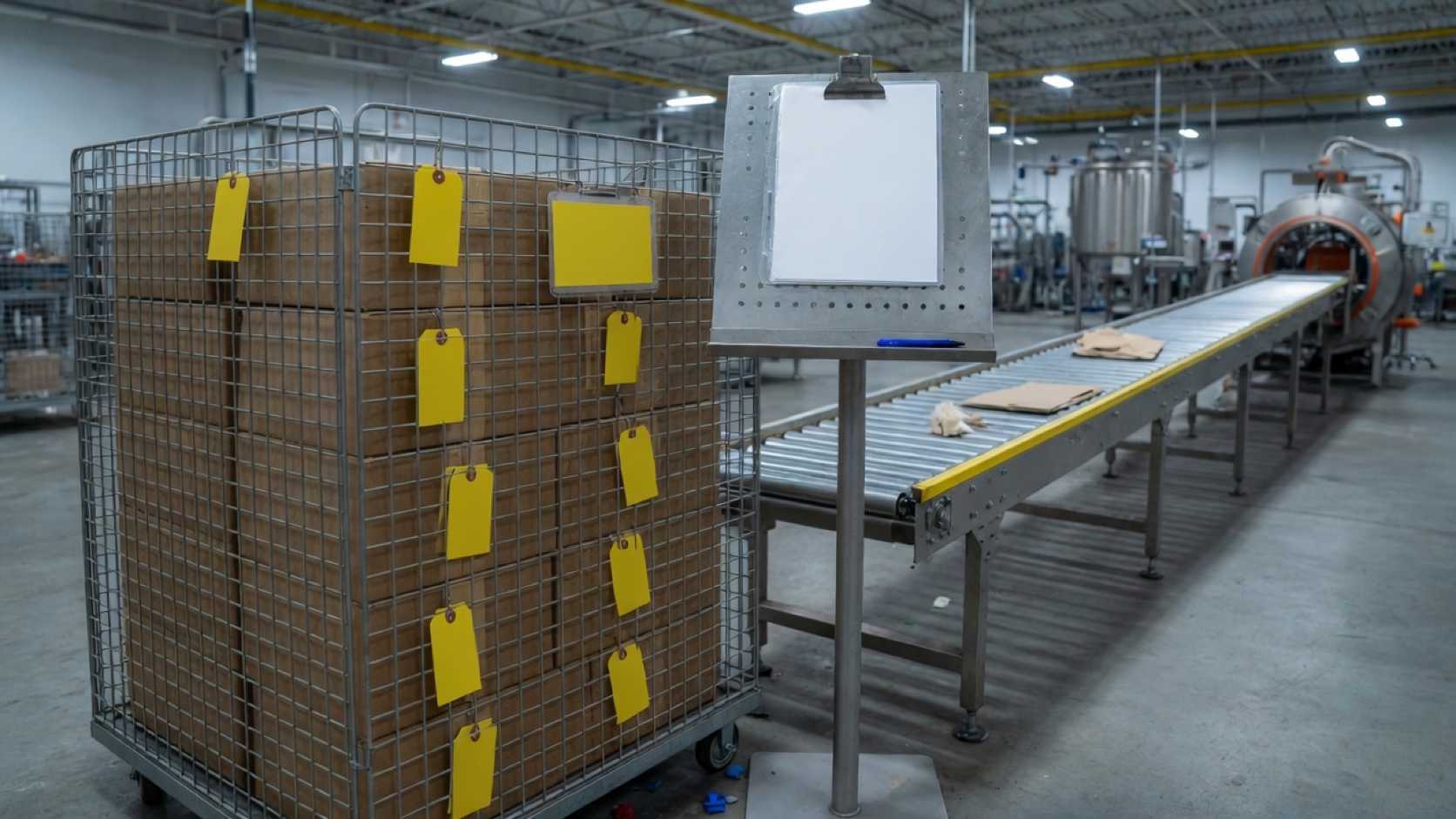
Quality is the most visible gap on the floor. Traditional metrics cited in NISTIR 8107 include yield, customer rejects or returns, and material authorizations or returns. NISTIR 8107, quality If the productivity numerator counts pieces leaving the line without looking at hold, rework, or reject, a “productive” shift can also be an expensive quality shift. The carton cage with yellow hold tags at line end never enters the ratio if nobody puts it in the formula.
Energy and materials follow the same pattern. When BLS defines multifactor productivity (also called total factor productivity), it compares growth in output with growth in a combined input set that includes labor, capital, energy, materials, and purchased services. BLS, TFP/MFP That list is not a line formula you must copy tomorrow. It is a map of what a labor-only denominator leaves out by construction.
If the committee conversation is about energy cost or scrap, kilos per person does not answer alone.
Capital and purchased services rarely appear on the shift sheet. Product mix and stoppage context rarely appear either. A high rate in a period with no changeovers is not comparable to a high rate in a period with three changeovers and a long stop, even if the labor ratios look similar. Stoppage context needs other evidence: timestamps, codes, asset boundaries. That discussion sits in downtime analysis with operational evidence, not in the productivity cell.
NISTIR 8107 also notes that a manufacturer’s sustainable competitiveness depends on cost, delivery, flexibility, and quality capabilities. NISTIR 8107, competitiveness One labor-pace cell does not cover that set. In customization contexts, the authors warn that volume-centered productivity measures may need adjustments to include response to customer demand. NISTIR 8107, customization If your plant runs high mix, a kilos-per-person figure that ignores changeovers and rush jobs can reward the easy lot and punish the shift that got the hard order out.
ISO 22400-2 adds another clue from the operations-KPI side: there is a 2017 amendment aimed at energy management indicators. ISO 22400-2:2014 / Amd 1 You do not need to buy the standard today to hear the editorial point: energy has its own place in the manufacturing KPI ecosystem. If your sheet calls a ratio without energy “productivity,” you are not breaking a law; you are misnaming a labor pace.
People often say: “if the number goes up, we are fine.” Sometimes that holds, when the question was only output rate per person-hour. Often it does not, when the question was total shift cost, deliverable quality, or whether the operation can keep going. NISTIR 8107 classifies key smart-manufacturing capabilities as productivity, agility, quality, and sustainability; sustainability includes environmental impact (energy and resources), safety and well-being, and economic viability. NISTIR 8107, capabilities
Raising the labor cell while quality or energy worsens is not hidden success. It is a partial indicator treated as a complete one.
Labor productivity versus multifactor productivity
On the floor, the same word often mixes different things. There is the informal sheet ratio (units/hour, kg/person-shift). There is labor productivity in the BLS statistical sense (output growth against hours growth). And there is multifactor or total-factor productivity, which brings in a wider input set. BLS Productivity
BLS presents the mission of its Office of Productivity and Technology as measuring how efficiently the United States converts inputs into goods and services. BLS, OPT That is a national and sectoral statistics mission. Among other series, it publishes manufacturing-sector labor productivity (output per hour). Those series exist and help with aggregate analysis. They are not a KPI for your line and not a threshold to paste into the daily report.
BLS multifactor productivity compares growth in output with growth in a combination of labor, capital, energy, materials, and purchased services. BLS, TFP/MFP Look back at the plant cell. You usually have labor there, and sometimes not even well-bounded hours. Capital, energy, and services almost never appear. The word “productivity” on the sheet sits closer to a local labor pace than to MFP.
NISTIR 8107 fits that distinction when it defines manufacturing productivity as output / process inputs and breaks it into labor productivity and material and energy efficiency. NISTIR 8107 Nobody is asking you to compute federal MFP in the locker room. The point is simpler: “productivity” is not an automatic synonym for “units per head.”
When is the labor view enough? When the decision is about pace and the other inputs are watched elsewhere with a clear owner: quality owns yield and rejects; maintenance owns stops; energy owns its own report. When is it not enough? When the same cell closes debates about cost, investment, or “who was more productive” across shifts with different mix and exclusions. In that second case, one ratio pushes conclusions the denominator cannot support.
Another common confusion: treating the BLS manufacturing series as a line benchmark. BLS publishes manufacturing-sector labor productivity among its recent figures. BLS, manufacturing sector That shows the labor concept exists at sector scale. It does not authorize saying “our line must beat the BLS quarterly X%.” Jurisdiction, method, aggregation, and purpose differ. To compare plants or shifts inside the company, first align definitions; that thesis sits in compare plant performance when sites measure differently, not in importing a national series.
ISO 22400-1 frames manufacturing operations management (MOM) KPIs within the scope of IEC 62264-1 for batch, continuous, and discrete industries. ISO 22400-1 ISA-95, also known as ANSI/ISA-95 or IEC 62264, organizes enterprise-control system integration and places manufacturing operations management at level 3 of its model. ISA-95 That boundary helps you remember where operations KPIs live: not in national statistics, but in the manufacturing operations domain. Your sheet can feed that domain or remain a shift note.
The difference is the measurement contract, not the cell color.
Call the ratio what it is. If it is output rate per person-hour, write that on the sheet. Keep “multifactor productivity” or “process productivity” for cases where the denominator includes more inputs on purpose. Loose language is how a partial number closes a full meeting.
What ISO 22400 adds without becoming an OEE tutorial
ISO 22400 is not here to replace your sheet or teach the A×P×Q formula step by step. It offers a framework for treating operations indicators as defined objects, not as cell nicknames. ISO 22400-1 specifies an industry-neutral framework for defining, composing, exchanging, and using manufacturing operations management KPIs. ISO 22400-1:2014 It gives a view of what a KPI is, construction criteria, terminology, and uses.
The 2014 publication was reviewed and confirmed in 2025; according to the catalogue, the version remains current. ISO 22400-1, status
ISO 22400-2 presents operations KPIs with formula, elements, time behavior, and unit/dimension; ISO/TR 22400-10 describes practical use of those formulae for control and monitoring together with the data-acquisition sequence. Part 2 specifies a selected set of current-practice KPIs and also indicates user group and production methodology. For equipment, those KPIs refer to work units per IEC 62264. ISO 22400-2:2014 ISO/TR 22400-10:2018 The useful message for the sheet: a serious KPI declares formula, elements, time, and unit.
Your “productivity” cell usually declares only the result.
We are not inventing the text of concrete Part 2 formulae here. The full standard sits behind paid access in the ISO catalogue. ISO 22400-2, availability From the abstract you can still assert the documentary structure. If you want the sheet closer to that rigor without buying the standard tomorrow, write numerator, denominator, period, exclusions, and work unit. That small card already changes the meeting.
ISO/TR 22400-10 describes practical use of ISO 22400-2 formulae for production control and monitoring, and it applies together with Part 2 content. The technical report title speaks to the operational sequence of data acquisition. ISO/TR 22400-10:2018 On the floor that means a formula in a PDF is not enough. You need to know where the data come from, in what order, and with what time cut. The informal sheet often skips that sequence.
The number shows up; the provenance does not.
NISTIR 8107 summarizes that ISO 22400 defines KPIs used in manufacturing operations management, and mentions an addendum aimed at energy management KPIs. NISTIR 8107, ISO 22400 That fits the energy amendment listed on the Part 2 catalogue page. ISO 22400-2 Amd 1 This is still not an OEE tutorial. It only makes clear that the operations KPI map is bigger than a labor pace.
ISA-95 supplies the layer map where that ecosystem lives. The standard describes enterprise-control integration and details, among other things, manufacturing operations management activity models in Part 3 (level 3). ISA-95 When ISO 22400 talks about MOM and work units via IEC 62264, it is talking about the same conceptual neighborhood. Your Excel cell can be a note outside that neighborhood or a summary someone treats as a MOM KPI.
The label matters because it changes which questions you can ask of the number.
The catalogue page is not the full normative text. Do not attribute paid formulae or universal “good” thresholds to this article. ISO 22400-2 appears in the catalogue with a status of International Standard to be revised. ISO 22400-2, life cycle Treat the framework as definition discipline, not as a closed text forever.
If you already measure OEE or other equipment KPIs, do not mix that conversation with the labor-productivity cell without saying so. They are different maps. OEE summarizes equipment losses over a declared period; kilos per person summarizes a labor pace. You may need both. They are not the same indicator under another name.
How to decide whether the spreadsheet number can support a decision
Skip “is this Excel scientific?” Ask whether this cell supports the decision you are about to take. The criteria below are about scope, not about software.
First: name the decision. Shift pace, shift comparison, bonus, cost, investment, or “are we fine.” Each one needs a different denominator. If you only need an output rate per person-hour, the informal cell can inform that decision; if the decision involves quality, energy, materials, or capital, the ISO 22400 KPI framework and the BLS labor/multifactor distinction indicate that more than one ratio is needed. BLS, TFP/MFP ISO 22400-1 NISTIR 8107
Second: write the contract next to the cell. Numerator (what counts as output). Denominator (hours, people, with what cut). Period. Exclusions (training, stops, indirect staff). Work unit or line boundary. Who may change the rule. Without that, the number travels as if it were comparable when it is not. ISO 22400-1 insists, at framework level, on criteria for building and using KPIs; ISO 22400-2 documents each KPI with formula, elements, time, and unit. ISO 22400-1 ISO 22400-2
Third: check the data sequence. Where does the numerator come from? Who validates it? Does the denominator use the same clock? ISO/TR 22400-10 exists precisely to talk about practical use of formulae and the operational sequence of data acquisition together with Part 2. ISO/TR 22400-10 If the numerator comes from a counter and the denominator from an informal attendance list, the ratio can be useful as a note and dangerous as a verdict.
Fourth: look at what stays out on purpose. Quality (yield, rejects, returns). Energy and materials. Stoppage context. Mix. Capital. NISTIR 8107 lists quality and sustainability as capabilities distinct from productivity alone, and defines sustainability with environmental impact, safety, and economic viability. NISTIR 8107, quality and sustainability If any of those faces decides the meeting, the labor cell needs company or it yields the floor.
Fifth: do not import national series as a line KPI. BLS labor and multifactor productivity measures describe conversion of inputs into goods and services at sector or national scale; they are not a line KPI. ISO catalogue abstracts do not replace the full text of paid formulae. BLS ISO 22400-1 ISO 22400-2 You can cite the shape of the ratio. You cannot paste the sector figure as a local target without breaking jurisdiction and method.
Sixth: separate workbook governance from indicator scope. You can have a well-versioned Excel with an incomplete formula, or a clean MES with the same scope ambiguity. Co-authoring and version control are another article. This page asks what the number claims. ISA-95 reminds you that the operations domain (level 3) has activity models and boundaries with the enterprise (level 4); a spreadsheet note does not inherit those boundaries automatically. ISA-95
Seventh: pick a concrete next step. Skip “improve data culture.” Paste under the cell a six-line block: numerator, denominator, period, exclusions, owner, allowed decisions. If the decision needs energy or quality, open the reading you already use for those areas, or add a second ratio with its own contract. If you need to compare plants, align definitions before you color rankings. If you want help mapping that evidence trail, contact WizeeMind.
If the number fails those filters, keep it, but bound its use. It informs pace. It does not deliver a verdict. An honest label prevents worse arguments than a new dashboard would fix.
Frequently asked questions
Is units per hour the same as labor productivity?
No. Units per hour is an output rate; if the denominator is elapsed shift or line hours, that rate can stay the same when staffing changes. Labor productivity, in the BLS sense, compares growth in output with growth in person-hours worked at sector or national scale, not as a line KPI. BLS, labor productivity On the floor you can still use an output/hours ratio as a local note, as long as you document numerator, denominator, and exclusions.
NISTIR 8107 defines manufacturing productivity as output against process inputs and breaks it into a labor face and material and energy efficiency; units per hour covers only one part. NISTIR 8107
Why can a “productive” shift on the spreadsheet hide poor quality or higher energy use?
Because the numerator usually counts gross or accepted output without requiring material and energy efficiency, and the denominator only looks at people or hours. Those hours can be elapsed shift hours or person-hours, and they are not equivalent. NISTIR 8107 cites traditional quality metrics (yield, rejects/returns, material authorizations) outside that labor ratio. NISTIR 8107, quality When BLS describes MFP/TFP, it includes energy and materials among the inputs that labor productivity alone does not capture. BLS, TFP/MFP
A hypothetical example: kilos per person rises while hold at line end grows; the cell can look “green” and the shift still expensive.
Can I use national labor productivity as my line KPI?
No. BLS series measure conversion of inputs into goods and services at aggregate scale; they are not a line KPI. BLS, OPT The existence of manufacturing-sector series does not turn that percentage into a shift target. BLS, manufacturing To compare lines or plants inside the company, first align the measurement contract; do not import a national series as a shortcut.
Does ISO 22400 force me to drop the kilos per person-shift formula?
No. ISO 22400 offers a framework for defining and using operations KPIs; it does not force you to abandon a documented local ratio. ISO 22400-1 gives concepts and construction criteria for KPIs; ISO 22400-2 documents selected KPIs with formula, elements, time, and unit. ISO 22400-1 ISO 22400-2 ISO/TR 22400-10 adds practical use and the data-acquisition sequence together with Part 2. ISO/TR 22400-10
What changes is the discipline: if you keep kilos per person-shift, leave in writing what it is and what it is not.
What should be documented next to the productivity cell?
Numerator, denominator, period, exclusions, work unit, and the decision that number can or cannot support. That minimum aligns with the ISO 22400-2 idea of presenting each KPI with formula, elements, time behavior, and unit, and with ISO/TR 22400-10’s emphasis on the data sequence. ISO 22400-2 ISO/TR 22400-10 Add the rule owner and the date of the last review.
If the decision involves energy, quality, or capital, also document which readings accompany the cell, or why the cell alone is not enough. ISA-95 reminds you that the operations domain has its own boundaries with business planning; do not assume a spreadsheet note inherits those boundaries. ISA-95