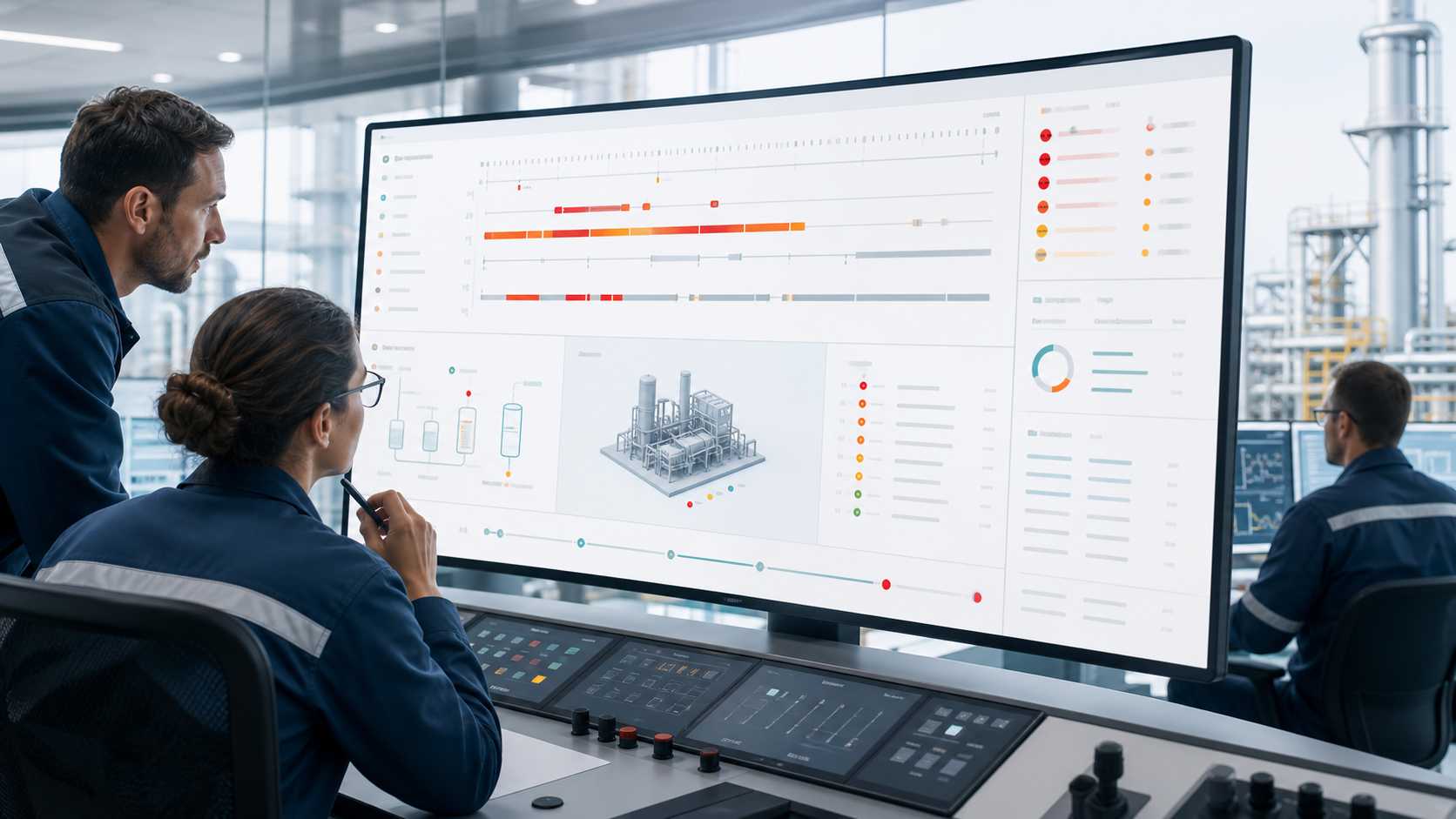
The quietest alarm screen in the plant can still be the most dangerous one.
That sounds backwards until a team reviews a messy event. A reactor temperature alarm appears. A pressure warning follows. A pump alarm repeats, clears, and returns. Five minutes later the banner is full, the operator has acknowledged what they can, and the first useful signal is already hidden behind consequences. Later, the review meeting has a list of tags and timestamps. What it does not have yet is evidence.
Good alarm management is not a campaign to make screens calmer. It is a discipline for proving which abnormal conditions require human attention, what response is expected, and whether the alarm actually helped at the moment attention was scarce. The HSE alarm management guidance puts the bar plainly: alarms should direct attention to plant conditions needing timely assessment or action. IEC 62682 takes the same work into lifecycle terms for process industries. The practical question is sharper: can another qualified person reconstruct why the alarm mattered?
Start with operator action, not alarm count
Alarm rate is tempting because it is easy to chart. Ten alarms per hour, twenty alarms per hour, floods per shift, standing alarms per unit: the numbers give managers something clean to compare. They do matter. But count is a weak proxy for usefulness. A plant can reduce the count and still leave operators with vague, poorly timed, or unactionable alarms. That is the contrarian point: the first question should not be “how many alarms do we have?” It should be “which operator action did this alarm support?”
The HSE guidance says every alarm should be useful, relevant to the operator, and tied to a defined response. IEC 62682 describes the primary function of the alarm system as notifying operators of abnormal process conditions or equipment malfunctions and supporting the response. Put those together and a bad alarm is not only a noisy tag. It is a broken promise: the system asks for attention without giving the operator a response path.
That changes the review packet. Instead of starting with a ranked list of most frequent alarms, the packet should preserve the working evidence for each candidate alarm:
- the abnormal condition represented by the alarm,
- the operator role expected to see it,
- the time available before escalation,
- the documented response,
- the operating mode where the alarm is valid,
- the evidence that the alarm appeared at the right time,
- and the evidence that the response was understood or followed.
Notice what is missing: a rush to delete. Nuisance alarms can deserve removal, but some deserve better limits, better priority, state-based suppression, repair of a failing instrument, or a clearer response procedure. The CCPS Beacon on nuisance alarms is blunt about authorization: do not change alarm set points unless authorized, and use management of change for alarm design, equipment, set point, or response procedure changes. EEMUA 191 also treats alarm systems as part of the operator interface to large industrial facilities, not as a decorative dashboard layer.
WizeeMind should help here by assembling evidence before the argument starts. If the defined response is missing, say that. If the alarm belongs only in startup or shutdown, show the operating mode. If the alarm is frequent because equipment is failing, surface maintenance context. The system should make weak evidence visible. A tidy screen is not the goal; a defensible operator decision is.
Reconstruct the first abnormal signal
Alarm floods are uncomfortable because the screen turns a process sequence into a pile. The reviewer sees pressure, temperature, status, permissive, and quality alarms in one list. The operator remembers the stress, not the exact order. A supervisor wants the plant back to rate. In that setting, the first abnormal signal is often the most valuable clue, and it is also the easiest one to lose.
The ISA-18.2 standard page identifies the standard as management of alarm systems for process industries. IEC 62682 says alarm systems include logs, historians, and performance metrics in addition to the HMI that communicates alarm information to the operator. Those pieces should work together. The alarm list tells what appeared. The historian tells order and duration. The HMI context tells what the operator could see. The operating record tells whether the process was steady, starting up, shutting down, changing grade, cleaning, or recovering.
Consider a simple event window:
09:12
Line speed increases after an upstream delay.

09:17
Zone 3 temperature deviation appears.

09:18
Feed pressure low warning appears.

09:19
Pump status alarm repeats and clears.

09:22
Related alarms appear across feed, temperature, and product flow.

09:28
Area stabilizes at reduced rate.

09:41
Pressure alarm remains standing after normal flow returns.
A flat list can make this look like a pressure problem, a pump problem, or a temperature problem depending on sorting. The sequence suggests a more careful next check: the first abnormal signal followed a rate increase, and later alarms may be consequences. That does not prove cause. It keeps the team from pretending that the loudest cluster is the origin.
This is where EEMUA 191 matters in practice. It describes alarms as support for operators by warning of situations needing attention and helping prevent, control, or mitigate abnormal situations. HSE points to the Milford Haven refinery incident as an example where operators faced a barrage of alarms for hours before the event. The lesson is not that every flood has one neat cause. The lesson is that chronology is evidence.
WizeeMind should reconstruct that chronology as a review packet, not a verdict. The packet should include last known normal state, operating mode, first abnormal alarm, related alarms that repeated or cleared, standing alarms left after stabilization, operator acknowledgement timing, action taken, and the next verification owner. In a plant review, that packet acts like a flight recorder transcript. It does not fly the plane. It stops everyone from arguing from memory.
Treat standing alarms as unresolved work
Standing alarms are easy to live with because they become part of the furniture. The banner always has that one pressure alarm. The analyzer alarm has been there since the last turnaround. The nuisance level alarm chatters during cleaning. People learn to work around the noise, and the workaround feels efficient until the day the same alarm masks a real condition.
The CCPS Beacon uses the old false-alarm story for a serious industrial point: unreliable or nuisance alarms can train people to discount warnings. It also tells operators to report nuisance alarms that chatter or remain in alarm condition and to work with instrument and automation engineers and management to fix them. HSE makes the complementary point that alarm systems need to accommodate human capabilities and limitations. Humans adapt. That is useful in production and risky in control rooms.
A standing alarm should therefore be treated as unresolved work, not as background texture. The packet should ask:
- When did it become active?
- In which operating modes did it remain active?
- Was there a documented response?
- Was the response followed?
- Did the alarm require action, or did it only describe a known state?
- Did maintenance, instrumentation, or control logic change before it appeared?
- What authorization is required before changing the alarm?
The answer can go several ways. The alarm may be valid and point to a plant condition that still needs attention. It may be technically active but poorly designed for current operation. It may be a symptom of an instrument fault. It may belong in one mode and not another. It may be missing a procedure. Each outcome has a different owner.
The human factors frame matters here. In James Reason’s paper on human error, major failures are understood by looking at system conditions and defenses, not only the active human action visible at the end of the sequence. ISA-18.2 is the standards home behind the lifecycle vocabulary for alarm management. The phrase “documented alarm rationale” sounds administrative. It is really a memory system for why the alarm deserves operator attention.
WizeeMind should expose standing alarms with that discipline. Show tag, state, duration, operating mode, related work orders, acknowledged repeats, response procedure, and proposed review path. If the fix touches logic, set point, priority, suppression, or response guidance, the system should point toward the site’s management of change route. It should not normalize the alarm just because everyone recognizes it.
Separate rationalization from cleanup
Many alarm projects begin with irritation. Operators complain about noise. Engineering exports bad actors. A team books a workshop. Someone wants the top twenty alarms gone before the next performance meeting. The pressure is understandable. It is also how cleanup can masquerade as rationalization.
Rationalization is slower because it asks whether a potential alarm meets the definition of an alarm and what must be documented for it. ISA-18.2 and IEC 62682 both frame alarm management as lifecycle work for process industries, not as a nuisance list. IEC 62682 also covers alarms presented through the control system, including basic process control systems, annunciators, packaged systems, and safety instrumented systems. That scope is wider than the alarms people happen to complain about this month.
Cleanup asks, “what is annoying us most this month?” Rationalization asks, “what abnormal condition requires timely operator response, and how do we prove the alarm is designed for that response?” One question may lead to the other, but they are not the same.
Here is a practical split:
- Cleanup removes obvious duplicates, repairs chattering instruments, and closes stale configuration mistakes.
- Rationalization verifies cause, consequence, corrective action, time to respond, priority, limit, and classification.
- Monitoring checks whether the alarm behaves as intended after the change.
- Management of change controls modifications that affect design, set points, equipment, or response procedures.
The CCPS Beacon supports that boundary by warning against unauthorized set point changes and calling for management of change when alarm design or procedures change. EEMUA 191 positions its guidance across design, management, and procurement for existing and new systems. That is lifecycle work, not a one-off purge.
WizeeMind should be opinionated about this boundary. It can rank repeated alarms, group related floods, and show stale alarms. But the output should avoid saying “remove this alarm” unless the plant’s approved workflow has already reached that decision. Better output is narrower and safer: “This alarm appears 312 times across seven days, has no linked response procedure, remains active during cleaning mode, and shares timing with a known instrument fault. Next review: instrumentation and operations rationalization before any set point or suppression change.”
That is less dramatic than an automated fix. It is more useful.
Build packets that preserve human authority
The best alarm evidence packet is compact enough to use on shift and detailed enough to survive a later audit. It should not read like a novel. It should read like a disciplined handover between operations, engineering, maintenance, and safety.
EEMUA 191 says alarm systems provide support by warning operators of situations needing attention and by playing a role in preventing, controlling, and mitigating abnormal situations. IEC 62682 adds that alarms are communicated through the HMI and supported by logs, historians, performance metrics, and external systems. That gives WizeeMind a narrow job: connect the evidence surfaces without taking over the decision.
A review packet should contain:
- alarm identity, priority, source system, and current state,
- operating mode and production context,
- first abnormal signal and event window,
- related alarms grouped by time and area,
- standing, stale, chattering, or repeated behavior,
- defined response and response evidence,
- missing procedure or missing rationale,
- maintenance, instrumentation, or process changes nearby,
- proposed verification owner,
- and change-control boundary.
The last item matters most. HSE emphasizes timely assessment or action by operators. The CCPS Beacon emphasizes training, authorization, and management of change. Digital support should respect both. WizeeMind can show that a pump status alarm is probably a consequence of a feed pressure condition. It can show that a standing alarm has no documented response. It can show that a temperature alarm appeared first after a rate change. It should not authorize suppression, change alarm priority, clear a safety alarm, or decide that a line is safe to restart.
The closing action for a plant team is practical. Pick one noisy alarm family this week. Pull seven days of event history. Rebuild the first abnormal signal for the worst flood. Check whether each alarm has a defined response, a valid mode, and a documented rationale. Flag standing alarms that remain active after the process returns to normal. Route any set point, suppression, priority, logic, or response change through the approved process.
That small packet will teach more than a prettier alarm dashboard. It will show whether the plant has evidence, or only a list.
Sources
- HSE: Alarm management
- ISA: ANSI/ISA-18.2-2016, Management of Alarm Systems for the Process Industries
- IEC: IEC 62682:2022 Management of alarm systems for the process industries
- EEMUA: Publication 191 Alarm systems - a guide to design, management and procurement
- CCPS: Are your alarms alarming?
- National Center for Biotechnology Information: Human error: models and management